Stoned-Campbell

  • Subscribe to our RSS feed.
  • Twitter
  • StumbleUpon
  • Reddit
  • Facebook
  • Digg
Showing posts with label Apocrypha. Show all posts

Tuesday, August 20, 2013

Prayer in the Apocrypha 3: Judith's Psalm of Praise

Posted on 11:35 PM by Unknown
"Therefore this is a fine, good, holy, useful book, well worth reading by us Christians. For the words spoken by the persons in it should be understood as though they were uttered in the Holy Spirit by a spiritual, holy poet or prophet who, in presenting such persons in his play, preaches to us through them." (Martin Luther, "Preface to the Book of Judith," in Luther's Works, vol 35, pp. 338-339).

Judith of Bethulia, Most Blessed of All Women

Few biblical characters have fascinated Jews and Christians as much a Judith of Bethulia.  As early as the first century Christian, Clement considered the "blessed Judith" to be a model of God given virtue and piety (1 Clement 55). Prudentius' "massively influential" Psychomachia (written about AD 405) inculcated the traditional Christian virtues of chastity, temperance, justice, fortitude, wisdom and humility through iconography of Judith [1].  Psychomachia remained very influential throughout the medieval period.  The lore of Judith found its way into sermons, Passover haggadah, Purim liturgy, Christian liturgy, prayer, plays, poems and art of the period molding and shaping of Judeo-Christian values.  Judith was a feature of one of the greatest "silent" movies of all time, Judith of Bethulia by D.W. Griffith in 1913.  She was a revered woman until the age of then Enlightenment.


Judith falls into two basic parts.  The first part describes the war of the Assyrians against the Jews (chapters 1-7); the second relates the deliverance wrought by God through Judith (chapters 8-16). [2]

Hostilities had broken out between the Assyrians and the Medes.  Nebuchadnezzar, who is pictured as ruling the Assyrians, calls on the western nations to help him against his enemies, however, they refused (1.7-11).  Angry and vowing to take revenge on them – including the Jews.  After defeating the Medes (1. 12-16) Nebuchadnezzar decides to destroy those who wished his downfall in the west.  He sends out his General, Holofernes, with 120.000 men and a further 12,000 cavalry.  Soon the nations were frightened into submission.

Meanwhile in the city of Bethulia the citizens, fearful that the Assyrians would defile the holy Temple of God, decide they will not acquiesce to Nebuchadnezzar.  The store provisions in anticipation of siege.  They seek God’s favor through prayer and fasting in sackcloth (4.1-15).  After thirty four days of siege with supplies running low the inhabitants of Bethulia began to loose heart and call upon the city elders to surrender to the Assyrians.  A leader, Uzziah, plead with them to hold out five more days, “By that time the Lord our God will show us mercy, for he will not forsake us utterly” (7.30).  Nevertheless, he agreed to capitulate to the Assyrians should help not come (7.19-32).

At this crucial point we are introduced to the Unlikely Source of God’s salvation for the Jews: a woman named Judith.  Her name simply means “Jewess.”   She is what all of God’s children ought to be.  Having heard what Uzziah has decided she steps way out of her “traditional” bounds as a woman.  She summons him and the elders and upbraids them for their lack of faith – and for attempting to force the hand of God with the time limit on him.  She says,

“Listen to me, rulers of the people of Bethulia! What you have said to people today is not right; you have even sworn and pronounced this oath between God and you, promising to surrender the town to our enemies unless the Lord turns and helps us within so many days. Who are you to put God to the test today . . .You cannot plumb the depths of the human heart or understand the workings of the human mind; how do you expect to search out God, who made all these things, and find out his mind or comprehend his though?” (8.12-14).

Judith volunteers for a dangerous mission – to be used by God to defeat the mighty Assyrian army.  She prays.  She emphasizes her weakness and vulnerability but also expresses amazing confidence in the God who is “God of the lowly, helper of the oppressed, upholder of the weak” (9.11).  She concludes her prayer by bringing to expression the main issue, her (and the author) the manifestation of who truly is God in this world (9.14). 


Judith ends up using the weakness of Holofernes, his arrogance and his desire for her beauty, to bring him down.    In one of the most painted scenes in western art, Judith decapitates a drunken Holofernes. Judith frankly acknowledges, “It was my face that tricked him to his destruction, and yet he committed no act of sin with me, to defile or shame me” (13.16).  Thus God wrought a powerful victory through the most unlikely of place for his people.  It is a delightful book with a powerful message.  Craven's conclusion is worth quoting,

"She is a widow in the midst of arrogant, cowardly, and uncompromising people. Her strength is striking precisely because it opposes the weakness of those around her.  Her heroism in Part II is in counterpoint to the hubris of Assyrian pride and Israelite presumption and despair in Part I." [3]

You can read more on the story of Judith in this "Judith: Radical Woman of God."

Brief Look at "Modern" Critical Issues

In the "modern" period Judith has suffered considerably at the hands of enlightened Protestant critics.  Totally reversing even the opinion of Martin Luther himself, noted in the opening, Judith has been turned into a liar, a sexual predator, a murderer and simply a dangerous woman!  Protestant scholarship of the Enlightenment till prior to World War II reflects not only the prejudice of those times but frequently is blatantly anti-Semitic (see deSilva's kind, in my opinion, of E. C. Bissell's to frequently quoted Introduction) [4].  The "problems" with Judith are not unique to her and often are simply problems because we do not understand the cultural issues involved in an honor/shame society [5].  I need not dwell on these issues.

The fascinating character Achior should be mentioned briefly.  Achior is the leader of the Ammonites (5.5).  When Holofernes is seeking counsel on how to defeat the Israelites of Bethulia in the quickest possible manner Achior delivers an amazing speech.  Achior reviews this history of God with Israel from the call of Abraham down to the Exile. Sounding like summaries of God's faithfulness through Samuel's Farewell Speech (1 Sam 12), Nehemiah's Prayer of Repentance (Neh 9), and Stephen's speech (Acts 7) Achior testifies that as long as the Israelites are faithful to "the God of heaven" (5.8) the Assyrians can never win.  Ironically this pagan has more confidence in the God of heaven than the ready to surrender inhabitants of Bethulia! Achior is ridiculed by Holofernes men and they declare, "We are not afraid of the Israelites; they are a people with no strength or power for making war. Therefore let us go ahead, Lord Holofernes, and your vast army will swallow them up" (5.23-24).  Achior is expelled from the Assyrian camp and is captured by the Israelites.  Later in the in the book, after Judith has slain Holofernes he "converts" to Israel.  "When Achior saw all that the God of Israel had done, he believed firmly in God. So he was circumcised, and joined the house of Israel, remaining so to this day" (14.10).  The author makes a direct parallel with the Abraham story in Genesis 15.6.  The expression episteusen to theo occurs only in two places in the Greek Bible (LXX) that is in Judith 14.10 and Genesis 15.6. Thus as Roitman has correctly noted, "according to the book of Judith, the righteous pagan who converts to Judaism would also have, as the native Jew has, Abraham as his model or 'father.'" [6] Such a perspective would be important in the Jesus movement embracing Gentiles on the model of Abraham. 

Judith's Psalm

 Prayer is an integral part of the story of Judith just as we discovered of Tobit [7]. In the tradition of Moses, Miriam, and Deborah, Judith leads the children of Israel in praise and worship of God through a "new psalm." What else can be done when God has delivered us and through the most unexpected means, but praise him.  Judith continues the long line of piety in the Hebrew Bible especially in the Psalter.  As with other biblical literature there is the rich use of previous biblical literature to nourish the Spiritual well being of God's people in a new day and situation.

"And Judith said, 
Begin a song to my God with tambourines,
and sing to my Lord with cymbals.
Raise to him a new psalm;
exalt him, and call upon his name.
For the Lord is a God who crushes wars; 
he sets up his camp among his people; 
he delivered me from the hands of 
my pursuers.
(Judith 16. 1-2b)

Judith, like the Prophet Miriam (Ex 15.20) and the young ladies in procession in the temple (Ps 68.25) grabs a tambourine and assumes the role of worship leader.  In the Bible, God's fresh act of grace demanded fresh praise.  We do not just sing the old song but now in light of God's new act we sing our own song of worship and praise.

The call to a psalm of praise is grounded in what God has done and is doing.  God "crushes" war.  Those drunk on the liquor of combat will be disappointed because the Lord simply will put an end to all war.  The vision or dream of the prayer is for a world without any more Holoferneses. What a day that would be.

But not only does Judith call to praise because God destroys war but because "he sets up his camp among his people." Following the destruction of God's enemies (i.e. war, etc) Judith praises God for one of the great blessings attested to throughout the Hebrew Bible, God lives with his people.  It is a vivid image that God "camps" with us.  God himself is the desire of the redeemed.

After narrating magnitude of Israel's dire straits from the Assyrian threat in verses 3 and 4, Judith gives God glory for the unbelievable way in which salvation was granted.  Only God could have accomplished salvation through a woman!

"But the Lord Almighty has foiled them
by the hand of a woman.
For their mighty one did not fall by the
hands of the young men,
nor did the sons of the Titans strike
him down,
nor did tall giants set upon him;
but Judith daughter of Merari
with the beauty of her countenance
undid him." (vv. 5-6)

The Lord God is given total credit for the unusual means of deliverance from the tyrannical Assyrians.  Judith does not even give God's enemy, Holofernes, the honor of being named he is just the "mighty one" who suffers the unbelievable (in that culture) of being done in by a woman, a widow no less! The irony drips form this portion of the psalm.  God did not use the demi-gods known as the "sons of the Titans," nor the legendary "giants" of the land.  God used a weapon fit for the occasion that undid the arrogance of an insatiable oppressor.  The beauty of an old lady (what delicious irony).  Should God not be praised?

Judith continues to narrate in the psalm how the God inspired actions of a widow had cosmic consequences.  The Persians and the Medes "tremble" with the news of what God has accomplished through one regarded so helpless (v.10).  Kicking into high gear Judith continues her "new song" of praise to the Lord.

"I will sing to my god a new song;
O Lord, you are great and glorious,
wonderful in strength, invincible.
Let all your creatures serve you,
for you spoke and they were made.
You sent forth your Spirit, and it
formed them;
there is none that can resist your 
voice.
For the mountains shall be shaken to
their foundations with the waters;
before your glance the rocks shall 
melt like wax.
But to those who fear you
you show mercy.
For every sacrifice as a fragrant offering
is a small thing,
and the fat of all whole burnt
offerings to you is a very little thing;
but whoever fears the Lord is great forever.

Woe to the nations that rise up against 
my people!
The Lord Almighty will take 
vengeance on them in the day of 
judgement;
he will send fire and worms into their
flesh; 
they shall weep in pain forever."
(vv. 13-17).

Judith has unwavering faith in the majesty and uniqueness of our God.  He is the Creator of all things.  Through the instrumentality of the Spirit life is given and the world is made. God's all powerful word (voice) cannot be resisted by his creation. Those in rebellion against his lordship (like Holofernes) will find themselves missing their head but mercy is the lot of those who walk the dangerous road of faith.

Judith warns her listeners that simply going to church and performing perfunctory acts of religious service like sacrifices, the "five acts" of worship, etc have no manipulative power over God.  Far from being some legalism Judith sees that such acts of worship are "little things" when divorced from the heart that "fears the Lord" has standing (and mercy!).

What Jesus and the Early Church Heard

It is exceedingly unlikely that Jesus did not know the story of Judith.  The very epitaph of Uzziah for Judith was applied to his own mother, "O daughter you are blessed by the Most High God above all other women ..." (13.18; Lk 1.42).  It is irrelevant if he believed it was or was not Scripture, though obviously many people of the day did.  But the story was one of those things that "filled the air." Through the story of Judith, Jesus heard that God overcomes insurmountable obstacles through the most extraordinary means.  He heard that God can accomplish things even through scandalous means.  Jesus and the Jews of his day learned from the story of Judith that women were people in an unique relationship with God and not mere appendages. Jesus and the Jews around him knew of stories of how God used women to do what no man could do.  Jesus heard that women were incredible prayer warriors and were inspired to not only deliver by His power but to lead in the worship of fresh new praise to the King of Kings.  Jesus and Jews of his day learned in the story of Judith that crises, oppression and suffering may be a means of divine testing rather than punishment [8].  Jesus learned through such stories as Judith that trust in the Lord is foundational, fundamental, and primordial basis of life.

These are not things that Jesus alone heard.  The first century church did as well.  We do not know when or by whom but Christians in the city of Rome knew the story of Judith even as John was penning his Gospel.  They assumed the Christians in Corinth knew who Judith was as well.  It is difficult to believe that Clement learned this on his own.  He almost surely learned if from an earlier disciple ... I realize I cannot prove that but it is certainly a reasonable supposition. Clement was asked to respond to a letter from the same church Paul had had so many issues with, that letter is known as 1 Clement and it is contemporary with the writings of John.  He exhorts them to unity and many other things.  A model of selflessness, graceful courage, and prayer is held out to the Corinthians.  It is one they surely already know, Judith.  I close with Clement's words for this is what the early church heard, just as Jesus had.

"Many women being strengthened through the grace of God have performed many manly deeds. The blessed Judith, when the city was beleaguered, asked of the elders that she might be suffered to go to the camp of the aliens. So she exposed herself to peril and went forward out of love for her country and of her people which were oppressed; and the Lord delivered Holofernes into the hand of a woman" (1 Clement 55)

Judith's daring act of faith, her willingness to sacrifice herself, her psalms of prayer and praise were among the things the Corinthians needed to appropriate to themselves.  Judith what a blessed woman she is.

Here is the movie, Judith of Bethulia, which was on of the most extravagant of films from the Golden Age of Silent Film.  Enjoy.


Notes:

1] See the richly textured study by Margarita Stocker, Judith Sexual Warrior: Women and Power in Western Culture (New Haven: Yale University Press 1998), quotes from pp. 24ff. 

2] Toni Craven has shown that Judith is an exquisite work of literary art.  The book falls into perfectly balanced halves where Judith emerges as the counterpart of the hubris of Assyrian pride and Israelite presumption.  See "Artistry and Faith in Judith," Semeia 8 (1977): 75-101.  

3] Craven, "Artistry and Faith in Judith," p. 95.

4] David A. deSilva, "Judith the Heroine? Lies, Seduction, and Murder in Cultural Perspective," Biblical Theological Bulletin 36 (Summer 2006), 55-61.  deSilva writes "Bissell was particularly disturbed about Judith's flirting with the ruing of her own sexual purity, going so far as to claim that she would have gone all the way with Holofernes if he didn't oblige her by passing out before consummating his desires ... Perhaps we should not be to surprised to find Bissell in a manner typical of late 19th century thinking about Judaism, condemning the religion of the author, which was able to stomach - indeed to bless - deception, teasing, and murder, but not the violation of the ceremonial law" (p. 56).  deSilva squashes this point of view for the make believe that it is. Luke certainly thought enough of Judith to use her as a model for Mary herself and probably Anna.  See the comparisons and contrasts in Brittany Wilson's excellent "Pugnacious Precursors and the Bearer of Peace: Jael, Judith, and Mary in Luke 1.42," Catholic Biblical Quarterly 68 (2006): 436-456.

5] In addition to the case specific study by David A deSilva mentioned in note 4 I recommend the very user friendly intro to the issues of "honor and shame" in the Eastern cultures in Randolph Richards and Brandon O'Brien's Misreading Scripture with Western Eyes: Removing Cultural Blinders to Better Understand the Bible (Inter-Varsity Press, 2012), 113-136.

6] Adolfo D. Roitman, "Achior in the Book of Judith: His Role and Significance," in No One Spoke Ill of Her: Essays on Judith, (Scholars Press 1992), 40, See p. 45 note 54 on Judith 14.10 and Genesis 15.6 in the LXX.

7] Toni Craven, "From Where Will My Help Come?: Women and Prayer in the Apocryphal/Deuterocanonical Books," in Worship and the Hebrew Bible: Essays in Honor of John. T. Willis, ed Patrick Graham, Rick Marrs and Steven McKenzie (Brill,    ), pp. 105-108.

8] Carey A. Moore, Judith: Anchor Bible (Doubleday 1985), 63. 
Read More
Posted in Apocrypha, Bible, Church History, Jesus, Jewish Backgrounds, Judith, Prayer, Spiritual Disciplines | No comments

Thursday, August 1, 2013

Prayer in the Apocrypha 2: Tobias & Sarah's Wedding Prayer

Posted on 2:08 PM by Unknown
"Tobit shows how things may go badly with a pious peasant or townsman, and there may be suffering in married life, yet God always graciously helps and finally crowns the outcome with joy, in order that married folk should learn to have patience and, in genuine fear of God and firm faith, put up gladly with all sorts of hardships because they have hope." (Martin Luther in his Preface to the Book of Tobit)

Setting the Scene

In our last, Prayer in the Apocrypha 1: Tobit and Sarah Cry in the Night, we suggested that the warm God-centered piety of this book is the kind that Jesus was reared in.  We suggested that Jesus the Jew heard, and probably said, the prayers in Tobit (or ones very like them).  The more we listen to Tobit and Sarah pray the more we are hearing the very prayers of all God's people - Jewish or Gentile.

When we left our last, Tobit and Sarah had both offered up prayers from the "deep" up to Merciful God of heaven in the faith that he, and he alone, would solve their woes. God heard those prayers and sent Raphael in disguise to answer both prayers by connecting these Israelites in Exile together.

Blind Tobit begins to set his affairs in order for he just prayed that he would be allowed to die. The Book of Tobit reveals deep respect for women through the character Tobit himself.  Just as Jesus takes care of his mother as he is dying (Jn 19.25-27), so Tobit who believes he will die makes sure Anna is provided for.

"My son, when I die, give me a proper burial. Honor your mother and do not abandon her all the days of her life. Do whatever pleases her, and do not grieve her in anything. Remember her, my son, because she faced many dangers for you while you were in her womb. And when she dies, bury her beside me in the same grave" (Tobit 4.3-4)

This window into how Tobit honors his wife Anna is revealing and corrects, as does the whole book, prejudicial notions that Jews in Jesus day held women in disdain and divorced them right and left (a presupposition that is not uncommon).  But Jewish family values were one of the very attractive things about Judaism to pagans themselves.  These values drew many into the fold as "god-fearers" associated with the synagogue. But I digress.

Tobias is commissioned to go on a road trip to Ecbatana.  He finds a companion he believes to be Azariah, but is really "Raphael" who stands in the presence of God.  The journey is a grand adventure finally arriving at the destination.  Along the way Tobias learns of his relative Sarah from Raphael who encourages him to "take her to be your wife in accordance with the law and decree in the book of Moses" (7.12). Tobias is understandably nervous because "Azariah" had informed him that she had already been married seven times and all the husbands had been murdered.  Tobias chooses the route of faith over security and decides to obey the angel in disguise.

Sarah's Salvation

When Raphael and Tobias arrive, introductions are made. Raguel, Sarah's father, is rightly ecstatic at the news of a potential husband for her.  Volunteers are hard to come by!!  Without a background check he sends his beloved wife, Edna, to prepare the bridal suite and then announces to his daughter: "Don't worry, Sarah, I'm sure the Lord of heaven will make you happy this time and not sad. So cheer up, my daughter" (7.18, TEV).  The NJB captures the mood nicely too "the Lord grant you joy in place of your sorrow."

Tobias and Azariah sit for a meal with Raguel, Edna and Sarah showing the solidarity of the family.  Then the parents escort their new son-in-law, along with Sarah, to their honeymoon room. As the door is shut Tobias whips out the rotting fish's heart and liver on the fire (on the instructions of Raphael).  Asmodeus, the wicked demon, is driven out and Raphael binds him hand and foot (8.3).  Sarah is free from the demon.

Prayer is the Way to Begin a Marriage

The new couple is quite unaware of the supernatural "battle" that took place (and left pretty much unnarrated by the author) the newly weds are still nervous about a great many things.  Getting a marriage off on the right foot is important, especially when you are number 8!! Or you have widowed seven times!!

For some marriage is a completely "secular" enterprise.  No thought of God and his kingdom purposes are even on the radar screen.  Surprisingly even some Evangelicals, and Restorationists, have been nearly as guilty as secularists in "profaning" the covenant of marriage.  Whether we agree with the Catholic tradition that marriage is a "sacrament" is immaterial but it is certain that the Hebrew Bible and Tobit imagine marriage to be a moment filled with holiness.  Marriage thus does not begin in sexual celebration - though the Song of Songs makes it quite clear the Bible has no qualms with sexual celebration in marriage.  Rather marriage begins in worship! I find the vision of marriage to be breathtaking beautiful and one that Christians today really need to capture (I write that as a divorced person sadly!).  Tobias "got out of bed."  He addressed his bride, "Get up, my dear" (TEV) or as the NAB reads much closer to the emotion of the text "My love, get up." The Greek of the LXX reads "adelphe" which is used in the Song of Songs as a tender way to refer to one's beloved (cf. 4.9, 10, & 12) [1].  "[L]et us pray and implore our Lord that he grant us mercy and safety." Together, husband and wife, begin their marriage kneeling in prayer to the God of mercy seeking his blessing upon them.

"Blessed are you, O God of our ancestors,
and blessed is your name in all generations forever.
Let the heavens and the whole creation bless you forever.
You made Adam, and for him you made his wife Eve
as a helper and support.
From these two the human race has sprung.
You said, 'It is not good that the man should be alone;
let us make a helper for him like himself.'
I now take this wife of mine,
not because of lust,
but with sincerity {of heart}.
Grant that she and I find mercy
and that we may grow old together."

And they both said, "Amen, Amen." (8.5-7)

The narrator has beautifully subverted our expectations as we have read the book.  We may have thought that journey would end in a climatic battle between the Angel who stands in God's Presence and Asmodeus, the King of Demons.  But no battle dominates. The binding is less than a verse and the contest is not a contest. Rather prayer dominates the entirety of chapter 8 (see remainder of chapter).

The newly weds prayer begins in doxology.  God is to be praised. Creation is admonished to bless the God of mercy.  The original human couple, Adam and Eve, are seen understood to be the model for all future marriages thus the couple quotes the Bible in their prayer.  They confess to God to be entering into this holy covenant with pure motives.  Tobias is not simply seeking a sex object ("not because of lust") to selfishly gratify his own needs. Righteousness and integrity before the Lord are the foundation of this marriage.  Finally they request two blessings to be upon their marriage that are simply holy and beautiful.  God give us mercy.  Anyone who has been married for any length of time, or has gone through the trauma of divorce, knows that mercy is actually a foundational element of the covenant of marriage.  God grant us mercy. And second Tobias and Sarah are not seeking a throw away marriage.  They seek God's mercy as a necessary ingredient to a lifetime of marriage. The image of praying, on your wedding night, that God allow you and your spouse to weather the storms of life with mercy growing old together is holy and beautiful. How often do we, as Christians, pray with our spouse for the blessing of growing old together? My guess is not nearly enough.

Wrapping Up

The marriage of Tobias and Sarah and their prayer has spoken to God's people nearly since the time the book was written. This passage has been used in Christian weddings for centuries. It remains part of the Roman Catholic liturgy for marriage.  Even the Amish use this passage as a model for marriage. I have used it in every wedding I have done since the late 1990s and it was incorporated into my own wedding to Tifani.

From Tobit we learn of the deep and reverent prayer that filled the hearts of Jesus' people.  From Tobit we learn that prayer was directed to One who was believed to hear prayer simultaneously from vastly different geographical areas. That prayer was offered to One they believed cared deeply about their lives and was intimately involved in the world bringing about shalom for his people and creation. We also learn from Tobit the aspirations of Jews regarding family and marriage.  It was a serious and holy thing rooted in creation and invoking the Presence of God himself as he blesses a marriage with longevity.  The faith of the prayers of Tobit, Tobias and Sarah are in the words of Toni Craven, demonstrate the answer to the question "from where does my help come?" God runs to his people to help them when they call on him in prayer [2].

I love Tobit. It gives me a window into the world of Jesus. Whether we accept it as Scripture like millions of Christians around the world matters not.  It is rich and wholesome and brings us closer to the aspirations of God's people in all times and all places.  And it helps us see Jesus in his own Jewish world with greater clarity and therefore with greater integrity.  I encourage you to pray the prayer of Tobias and Sarah ... with your spouse. 

Notes:

1] Unfortunately the Hebrew and Aramaic fragments of Tobit from Cave 4, one that dates to at least 100 B.C., only partially preserve chapter 8.  For an English translation of the Dead Sea Scrolls Tobit see Martin Abegg, Jr, Peter Flint & Eugene Ulrich, The Dead Sea Scrolls Bible (HarperSanFrancisco, 1999), 635-646.  Joseph A. Fitzmyer has published a thorough study of the Hebrew and Aramaic remains of Tobit from Qumran in "The Hebrew and Aramaic Fragments of Tobit from Qumran Cave 4," Catholic Biblical Quarterly 57 (1995): 655-675.  Fitzmyer believes the original language was Aramaic rather than Hebrew but then says that that is not certain by any means.  Fitzmyer has, since this article, published a full scale Commentary on Tobit that I have not been able to consult (out of my price range to buy :-(  )

2] Toni Craven, "From Where Will My Help Come?: Women and Prayer in the Apocryphal/Deuterocanonical Books," in Worship and the Hebrew Bible: Essays in Honor of John T. Willis, ed. Patrick Graham, Rick Marrs, and Steven McKenzie, pp. 95-109.  Tobit is covered on pages 99f.


Read More
Posted in Apocrypha, Bible, Jesus, Jewish Backgrounds, Marriage, Prayer, Spiritual Disciplines, Tobit | No comments

Friday, July 26, 2013

Prayer in the Apcrypha 1: Tobit and Sarah Cry in the Dark Night

Posted on 6:53 PM by Unknown


 “The prayer of the humble pierces the clouds, and it will not rest until it reaches its goal; it will not desist until the Most High responds and does justice for the righteous and executes judgment” (Sirach 35.21, NRSV)

Jesus, the son of Mary, was born to a faithful Jewish family.  The Gospel of Luke opens a window into the kind of piety that Jesus was immersed in as he grew in “wisdom and in years, and in divine and human favor” (2.52). The vignette of the young Jesus in the temple is something that is presented as typical not extraordinary for his Jewish family (2.41). Jesus would continue as an adult to participate in the pilgrimages to Jerusalem to worship the God of his ancestors (John 5-12). The Gospels are peppered with prayer from the lips of Jesus. 

But it was not just Jesus and his family that were devoted to prayer.  The Jewish people were serious about prayer. When the disciples asked Jesus, “Lord, teach us to pray” (Lk 11.1) they are not implying they were not, or that Jews were not, people of devoted prayer. In fact we often gravely distort, not only Jesus’ mission & message, but the entire NT when we take him and the NT church out of their Jewish context. Caricatures of Judaism’s faith and practice as legalistic, formalistic, harsh, etc, etc. has been a cottage industry among Western Christians for far to long [1]. Even though the evidence is blaring like neon lights in our face we still sometimes turn Jesus not only into a gentile but a European gentile! Thus it is important to remind ourselves of his immersion in Jewish faith and practice. But what was that “faith and practice?” We will look at a few select prayers in the Apocrypha (or Middle Testament) to learn of the “heart and soul” of the prayers Jesus heard and possibly even prayed himself. In the process we will be edified and come closer to the Lord who remains among his people leading us in prayer and singing praises to our Abba (cf. Heb 2.12f).

Prayer in the Apocrypha: Tobit & Sarah

Prayer in the Apocrypha covers every conceivable area of life from war, travel, food,
procreation, to safety, and much more [2]. I have dealt with Tobit rather broadly previously (Here: Tobit: Triumph of Faith in Adversity) and in relation to Jewish worship previously (Here: The Worship of God; Insight from the Apocrypha) so I am not going rehash that material. I offer this brief structural outline of the book for contextual purposes

I. Shame and Depression of Tobit and Sarah (ch's 1-3)

II. Raphael Sent by Grace to Journey with Tobias incognito  (ch's 4-6)

III. Deliverance of Sarah and her Marriage to tobias (ch's 7-10)

IV.  Raphael escorts the newly weds back and Delievers Tobit (ch's 11-12)

V. Tobit's Prayer of thanksgiving and Testament to Tobias (ch's 13-14

The book of Tobit is rich in prayer.  Indeed prayer is one of the most pervasive themes.  The prayers of Tobit and Sarah make up the bulk of chapter three. The prayer on the night of the wedding of Tobias and Sarah in chapter 8 and the prayer of praise by Tobit in chapter 13 are profound. 

Setting the Scene

Tobit, along with his wife Anna and son Tobias, are among the faithful Israelites that are hauled off with the rest of Israel by the Assyrians to Exile after the collapse of Samaria in 722 B.C. Unlike his fellows, he had journeyed to Jerusalem to worship the one true God according to the covenant of Moses. He delighted in temple worship (we easily hear him singing joyfully the Songs of Ascent). In Exile worship at the temple is no longer possible, so he finds other ways of being faithful to Yahweh.  He gave his food to the hungry and poor, clothed the naked and buried the dead (2.17).  Leaving the bodies exposed was an intended insult by the Assyrians, but Tobit in acts of “civil disobedience” buried them earning the wrath of the overlords. Tobit went into hiding but after the death of the tyrant he returns.  He resumes his ways of helping the poor by telling his Tobias (sounding much like a parable of Jesus btw) to go out and find any poor person he can find so he/she can enjoy the provisions of Pentecost too. He would not eat till the poor come sit and dine at his table. Tobias, however, finds a dead Israelite to whom Tobit immediately goes to bury.  Sleeping outside because of his ritual uncleaness Tobit becomes the victim of bird droppings in his eyes and looses his sight. Four years later his wife, Anna, is having to earn food for the family.  She brings home a goat that had been given her for her wages. The blind, and humiliated, Tobit lashes out (wrongfully) at his wife.  True to any genuine relationship, she, stung by his accusation, shouts “Now I see what you are really like! … Where is all that concern of yours for others?” (2.14, TEV). [3]. Crushed by his suffering, in Exile, blinded while doing kingdom work, alienated from his wife, and now even unable to do works for Yahweh he prays that God would take his life.

Meanwhile, Sarah's life is even worse (!) than Tobit’s.  She is the only child of Raguel, a Jew exiled to Ecbatana in Media (cf 2 Kings 17.5-6) hundreds of miles away. She is attacked by her father’s maid because she had been married seven times but “the worst of demons” Asmodeus (3.8, NJB) had killed each bridegroom before they could consummate the marriage.  We learn later in the story that each of these were killed in the bridal chamber itself (6.14). The maid accuses Sarah of actually murdering her own husbands bringing dishonor to her and her family. Now she believes that there is no hope and intends to commit suicide (3.10). But she realizes that doing so would further dishonor her father so she also prays that the Lord take her life or to do as he pleases.

The Prayers: Ad Dominum cum tribularer

The narrator brilliantly, and inspiringly, conveys how the lives of Tobit and Sarah are parallel and that the Lord, even though far from the “holy land,” cares and knows about what is happening to both. Both cry out to the Lord in the midst of their troubles. Quotations come from John Kohlenberger III’s The Parallel Apocrypha with Greek, KJV, Douay, Know, TEV, NRSV, NAB and NJB in parallel columns.  I follow the more literal NRSV here. Tobit prayed

“Then with much grief and anguish of heart I wept, and with groaning began to pray:

‘You are righteous, O Lord,

and all your deeds are just;

all your ways are mercy and truth;

you judge the world.

And now, O Lord, remember me

and look favorably upon me.

Do not punish me for my sins

and for my unwitting offenses

and those of my ancestors committed before you.

They sinned against you,

and disobeyed your commandments.

So you gave us over to plunder, exile, and death,

to become the talk, the byword, and an object of reproach

among all the nations among whom you have

dispersed us.

And now your judgments are true

in exacting penalty from me for my sins.

For we have not kept your commandments

and have not walked in accordance with truth before you.

So now deal with me as you will;

and command my spirit to be taken from me,

so that I may be released from the face of the earth

and become dust.

For it is better for me to die than to live,

because I have had to listen to understand insults,

and great is the sorrow within me.

Command, O Lord, that I be released from this distress;

release me to go to the eternal home,

and do not, O Lord, turn your face away from me.

For it is better for me to die

than to see so much distress in my life

and to listen to insults.” (Tobit 3.1-6, NRSV)

And Sarah prayed …

“At that same time, with hands outstretched toward the window, she prayed and said,

‘Blessed are you, merciful god!

Blessed is your name forever;

let all your works praise you forever.

And now, Lord, I turn my face to you,

and raise my eyes toward you.

Command that I be released from the earth

and not listen to such reproaches any more.


You know, O Master, that I am innocent

of any defilement with a man,

and that I have not disgrace my name

or the name of my father in the land of my exile.

I am my father’s only child {uses monogenes here just as in Jn 3.16}

he has no child to be his heir;

and he has no close relative or other kindred

for whom I should keep myself as wife.

Already seven husbands of mine have died.

Why should I still live?

But if it is not pleasing to you, O Lord, to take my life,

hear me in my disgrace” (Tobit 3.11-15, NRSV)

Praying Out on the Limb

Not only can I, but I do, identify with both Tobit and Sarah.  Twice in my life I have felt the world simply crashing in on me.  The first time was being fired for teaching that racism is absolute sin before God almighty – and this before Christmas! I thought I was going to get a pay raise but instead got two days to “get your books out of the office.” Did I ever feel wronged and confused. The other was when I was divorced by my wife of 17 years - left on a Sunday morning!! (No joke!) Oh how I felt like less than zero.

Many of us, just as Tobit had literally gone above and beyond the “letter of the law” in trying to show he was on the Lord’s side only to have a bird literally poop in his eyes.  In his “eyes” he was shamed, of no count. Less than Zero. And now he has wrongfully accused his wife. Shame upon shame! Sarah whose problem was not being barren like the ancient Matriarch, rather it was that her husbands keep dying before they can even have sexual intercourse.  She is the talk of the town and the maid voices what the whole town thinks – she is really murdering her men! Her father is shamed because of her and he has no heir because of her!  She, like Tobit, see no light at the end of the tunnel.  They are out on a limb that has just been cut off.

In the Scriptures that Jesus drank from childhood he encountered numerous prayers from the Pit. I believe the Gospels make it clear that Tobit is one story he knew.  At any rate the Psalms are littered with lamentations where the people are overwhelmed by the “odds.” “In my trouble I cried to the Lord, and he heard me. Lord, deliver my soul from liars and from deceitful people” (Ps 120). “Out of the depths I have cried to you, Lord” Lord, hear my voice.” (Ps 130).  Space does not allow quoting Psalm 88 in full but clearly Tobit and Sarah would feel at home in that psalm. When was the last time you took the time to read the book of Lamentations?

Other prayers in Scripture even reveal a desire for death.  Job clearly hates the day he was born and desires to be set free from his misery (Job 3).  Jonah twice tells Yahweh he would rather be dead than live in a world where he lets scum off like he did the Assyrians (Jonah 4).  But Jonah’s death wish is motivated out of anger at God.  Tobit’s and Sarah’s is motivated by anguish at the present and no hope for the future [4]. With such prayers being replayed in his head (like Ps 22), Jesus himself, like Tobit, released his spirit, to die (Tob 3.6)

Tobit’s prayer has three parts. First it has a doxology (3.2).  Second is Tobit’s recognition of his own sin and his identification with the failures of the entire people of God. He neither blames them nor denies his sharing in their guilt (3.3-5). Third his fervent petition to be released from his shame and blindness.

Sarah’s prayer is presented as just as important to God (and the narrative) as Tobit’s. She is in different circumstances but the same turmoil.  God cares for both men and women. He listens to both. He responds to both. He is Sovereign over all the world even the Assyrian Empire to bring about his will in the lives of his people.

Unlike Tobit, Sarah has no qualms about asserting her innocence before the Lord. She has been faithful and remains even a virgin despite being in an alien land where her virtue could easily have been compromised by slavers. She lives with the horrid memory of being wed only to literally watch seven husbands destroyed by Asmodeus. But who knew the truth but her?

Wrapping Up

Tobit and Sarah’s prayers reveal faith in a God who is not only powerful but who is merciful and full of truth (or “grace and truth” in NJB in 3.2 much like in John). They believe that God is the only one who can address their problem. Tobit seems to only see death as the only option but Sarah leaves open the door for “your will to be done” [5]. Both reveal an unshakable faith that God is to be praised regardless of the circumstances and that his justice is flawless even in their less than favorable circumstances.

Finally the author of Tobit reminds us that even though those seeking God’s favor are far from the Temple that “at that very moment, the prayers of both of them were heard in the glorious presence of God” (3.16). God sent his angel Raphael not to take the lives of Tobit and Sarah but to deliver him from his blindness so he could “see the glory of the Lord” and to save Sarah from her shame and set her free from the tormenting demon.  The rest of the story is God fulfilling the prayer of two very different people separated by many miles, with very different problems and yet God mysteriously linked them together.

Stories and prayers like these showed Jesus and the early church that God was every present and mysteriously and deeply involved in the world. Faith in him is the victory. These prayers are powerful and show us the kind of prayer Jesus and his followers heard and prayed ...

The Art Work ...

Tobit, like much of the Apocrypha, was treated as canonical Scripture by artists.  There are stunning works of art on themes from the Middle Testament.  The sculpture at the top is by Giovanni Baratta (1670-1747).  The illuminated page is the title page of Tobit in the Gutenberg Bible. And the tapestry is by Neri di Bicci dating to 1471. 

Notes

1] The sad sordid tale of Christian anti-Semitism is chronicled ad nauseum by Dan Cohn-Sherbok, The Crucified Jew: Twenty Centuries of Christian Anti-Semitism (Grand Rapids: Eerdmans 1992).

2] See Norman B. Johnson’s, Prayer in the Apocrypha and Pseudepigrapha (Philadelphia: Society of Biblical Literature, 1948), 7-37. Johnson’s work is both valuable and frustrating. He arranges his brief study topically with little attention to the context in which the prayers occur. His study is also tainted with a not so subtle condescending attitude toward Second Temple Judaism that colors more than one of his interpretations. Nevertheless with that said it is still a good entre into the field of prayer in the Apocrypha.

3] Amy-Jill Levine, a wonderful Jewish scholar has called attention to the domestic relations   between Tobit and Anna in a very insightful article, “Tobit: Teaching Jews How to Live in the Diaspora,” Bible Review 8.4 (August 1992), 42-51, 64.  Where I disagree with her, is her conclusion that the Book of Tobit is concerned with keeping in Anna and Sarah “in their place.”  I really think this is a major imposition upon the text.

4] See the oh so brief discussion in Cary A Moore,Tobit, Introduction and Commentary (New York: Doubleday 1996), 139-140.

5] David deSilva correctly, in my judgment, sees Sarah’s prayer as a “model” for praying, as James will direct, “according to God’s will.” See Introducing the Apocrypha: Message, Context, and Significance (Grand Rapids: Baker Academic 2002), 78.
Read More
Posted in Apocrypha, Jesus, Jewish Backgrounds, Ministry, Prayer, Spiritual Disciplines, Tobit | No comments

Monday, August 15, 2011

Book of First Maccabees: God's Family of Deliverance

Posted on 10:54 AM by Unknown


I continue in this post with our journey through the Ancestry of the King James Version with a look at another of those books in its table of contents that never appeared in a New American Standard or NIV. I hope you enjoy it.


First Maccabees recounts how those doughty defenders of God’s People, Mattathias and his five sons, delivered Israel from Antiochus IV and the “renegade Jews” resulting in political freedom for Israel first time in four centuries. The author, whose name has not been preserved, gives us with a carefully crafted history showing Judas and his brothers to be the divinely appointed agents of salvation for Israel. The ideology of 1 Maccabees would shape Jewish nationalism and messianic hopes for the next three centuries and has tremendous value in understanding the hope of Israel in the time of Jesus. The love and respect for Judas is seen when he passes in these words, “How the mighty is fallen, the savior of Israel!”


Introductory Matters


First Maccabees was written shortly after 134 BC in the Hebrew language. The book, however, survives in Greek, Syriac, Old Latin, Vulgate and Armenian translations. The early church father, Origen, seems to have known the book in its Hebrew version (cf. Eusebius, Ecclesiastical Histories, 6.25) but was known as “The Book of the House of the Hasmoneans” or “The Book of the House of the Princes of God.”


The story of 1 Maccabees divides neatly into three main parts: The Crises and Mattathias response to it (1.1-2.70), the exploits of Judas (3.1-9.22), and the exploits of Jonathan and Simon (9.23-12.53; 13.1-16.24).


Luther on First Maccabees


We have seen that Luther, though rejecting the canonical status of Apocryphal books, held most of these books in very high regard. Likewise, 1 Maccabees was a great book in Luther’s eyes. He translated the book for his German Bible in 1533, here are a few words from his Preface to the First Book of Maccabees:


This is another book not to be found in the Hebrew Bible. Yet its words and speech adhere to the same style as the other books of sacred scripture. This book would not have been unworthy of a place among them, because it is very necessary and helpful for an understanding of chapter 11 of the prophet Daniel. For the fulfillment of Daniel’s prophecy in the chapter, about the abomination and misfortune which was going to befall the people of Israel, is here described – namely, Antiochus Epiphanes – and in much the same way that Daniel [11.29-35] speaks of it . . . This [among other reasons] is why the book is good for us Christians to read and to know. (Luther’s Works, vol. 35,pp. 350-352).


The Crises of the Maccabees


The “crises” of Maccabees was that of Hellenization. God’s People had existed peacefully under other Greek rulers like Alexander and the Ptolemies of Egypt. However, there arose a “sinful root” (1.10) known in 1 Maccabees as Antiochus Epiphanes the ruler of the Seleucid Empire. As the author of 1 Maccabees makes clear the problem is not only Antiochus but renegade Jews who wish to undermine the law of God:


In those days lawless men came forth from Israel, and misled many saying, ‘Let us go and make a covenant with the Gentiles round about us, for since we separated from them many evils have come upon us.’ This proposal pleased them, and some of the people eagerly went to the king. He authorized them to observe the ordinances of the Gentiles. So they built a gymnasium in Jerusalem, according to Gentile custom, and removed the marks of circumcision, and abandoned the holy covenant. They joined with the Gentiles and sold themselves to do evil (1.11-15, RSV).


Soon things went from bad to worse. Antiochus invaded Egypt defeating their armies and for good measure decided to “enter the sanctuary” and loot the temple (1.21-24). He soon stationed troops in the city and began a zealous program of converting the Jews to enlightened paganism. He demanded that “alters and sacred precincts and shrines for idols, to sacrifice swine and unclean animals and to leave their sons uncircumcised” (1.47-48). The Torah was confiscated and burned. In a very moving passage we read about the courageous faith of certain Jewish women,


According to the decree, they put to death the women who had their children circumcised, and their families and those who circumcised them; and they hung the infants from their mothers’ necks. But many in Israel stood firm and were resolved in their hearts not to eat unclean food. They chose to die rather than be defiled by food or to profane the holy covenant; and they did die. And very great wrath came upon Israel (1.60-64).


The Maccabaean Response


The revolt against the Seleucid king began in a small town named Modein. The king’s representative set up an alter and called the people to come and sacrifice on it. Mattathias’ was encouraged to take the lead in this activity but refused.


Even if all the nations that live under the rule of the king obey him, and have chosen to obey his commandments, everyone of them abandoning the religion of their ancestors, I and my sons and my brothers will continue to live by the covenant of our ancestors (2.19b-20).


However, when a “lawless” Jew stepped forward to comply, Mattathias killed him and the king’s men. The author explicitly links the “burning” zeal of Mattathias to that of Phinehas (2.26, cf. Numbers 25.6-15). Mattathias soon dies and leadership passes to his son Judas.


One of the moving testimonies to the faith of Judas comes in chapter 3 when he has to face the massively superior force of Seron, commander of the Seleucid army. His men are faint with fear. Judas exhorts his troops with a faith building speech,


It is easy for many to be hemmed in by few, for in the sight of Heaven there is no difference between saving by many or by few. It is not on the size of the army that victory depends, but strength comes from Heaven. They come against us in great insolence and lawlessness to destroy us and our wives and our children, and to despoil us; but we fight for our lives and our laws. He himself will crush them before us; as for you, do not be afraid of them. (3.18-22).


The “Abomination of Desolation”


One of the major issues in 1 Maccabees relates to Daniel 11.31. Following the decree of Antiochus a series of provocative acts were made against the faith of Israel: the desecration of the alter of burnt offering outside the temple; the building of alters through-out Judea; the destruction of the books of Torah; and finally, the ultimate, the offering of illegal sacrifice “on the alter which was upon the alter of burnt offering (1.54-59). The dates of the 15th and 25th of Kislev in 168 B.C. are clearly remembered as the ultimate sacrilege.


First Maccabees speaks of the erection of a bdelugma eremoseos, a “desolating sacrilege” or “abomination of desolation” upon the alter of burnt offering (cf. Daniel 11.31 and a variants of the phrase in 8.13; 9.27; 12.11). This phrase is picked up in the New Testament in Mark 13.14 and Matthew 24.15. The question is what does the phrase mean to our author? Most scholars think it refers to a derogatory parody of the Syrian god, Ba’al Samen (“Lord of Heaven”). This god of heaven is then related to Zeus Olympios (cf. 2 Macc. 6.1) in whose name the temple was rededicated. Thus Antiochus wants the Jews to worship an alternative god with unclean sacrifices (for more details see John R. Bartlett, 1 Maccabees in the Guides to Apocrypha and Pseudepigrapha Series, pp. 64-65).


Influence of 1 Maccabees


First Maccabees is an invaluable work for understanding the social situation of Jesus and his early disciples. The Maccabees shaped the political ideology that would fuel messianic movements in Judaism for centuries. The beliefs that God would grant victories in the face of overwhelming odds would motivate all would be liberators of Israel in the Roman period.


The model of a military messiah comes shining through the pages of the NT. For example John and James are portrayed as regarding their association with Jesus as a chance to gain temporal power after a revolution (Mark 10.35-45). The messiah figure of Judas Maccabeus certainly is in their minds. In the trial of Jesus, the Jewish and Roman accusers assume a connection between messianic claims and political subversion. In Acts 1.6 the disciples are still searching for a (seemingly) political restoration of the kingdom of Israel.


First Maccabees equates “zeal for the law” with violent action against renegade or apostate Jews (as well as Gentiles). This notion permeates the Zealots and Sicarii assaults on Jewish collaborators, and it also sheds considerable light on Paul’s own zeal to destroy those whom he imagined to be apostates.


The continuing influence of 1 Maccabees is seen in the celebration of Hanukkah (See Jesus the Jew and Hanukkah). The rabbis were quite familiar with the story of Maccabees and we have seen that Josephus used 1 Maccabees 1-13 in writing his history of the Jews. The book enjoyed popularity in the early church as well. But as we will see 2 Maccabees left a larger impression because of its glorification of martyrdom. The Hebrew Preacher lauds the Maccabees in his Hall of Fame of Faith (See Jewish Traditions in Hebrews 11).

Read More
Posted in Apocrypha, Bible, Jewish Backgrounds, King James Version | No comments

Tuesday, July 26, 2011

Prayer of Manasseh: The Heartbeat of Jewish Spirituality

Posted on 8:18 PM by Unknown

Light of Grace Bursts Forth

The Prayer of Manasseh is one of the most beautiful prayers ever written - even if it is in the Apocrypha. (See also my: Apocrypha: Reading Between the Testaments; Praying with Romans & Manasseh; Apocryphal Myths: Great is the Truth and Mighty above All Things.

Prayer. The word itself ushers us into the realms of something deeper and richer than ourselves. Prayer. Prayer is the witness to dynamic faith in a personal deity though transcendentally on high is deeply involved with creation. Prayer. Prayer is to humanity's walk with God what hugs, kisses and sex are to a healthy, God honoring marriage. Prayer. Prayer is, in a way, God's own Spirit crying out from within us in order to connect us once again with the Lover of our Souls: the Triune God. Prayer. Prayer connects us to the rhythm of grace and immerses us in the river of the Spirit. Is it any wonder that prayer seasons the biblical story from Genesis to Revelation?

Prayer remained an intimate part of the life of Jews in the centuries before Jesus and the early church. The Apocrypha is literally peppered with prayers. Years ago Norman B. Johnson wrote in his Prayer in the Apocrypha and Pseudepigrapha that nothing reveals a peoples true heart as the prayers they pray. Prayer reveals, ironically, what they believe about God ... it is the unveiling of their "doctrine" of God. If this is true then the Prayer of Manasseh is the heartbeat of Jewish spirituality ... a light of grace bursting forth against the darkness of evil!

Evil Incarnate - Manasseh

To understand Psalm 51 the editors of the Psalter wrote a heading for it: "A Psalm of David, when the prophet Nathan came to him, after he had gone into Bathsheba." This great penitential psalm is gripping against the backdrop of the the whole sordid sad affair in 2 Samuel 11-2 Kings 2.

Likewise to understand the Prayer of Manasseh, and its radical claim, we must know who Manasseh was. The story of the king is told two times in very different ways in the Hebrew Bible (2 Kings 21.1-18 & 2 Chron 33.1-20). Kings, written to explain "why" Israel was "here" (exile) rather than "there" (promised land) describes Manasseh as the incarnation of evil. He even led pagan worship in human sacrifice of his own son. Manasseh's sin almost makes David's look, by comparison, small. He was the straw that broke the camels back. Yahweh's long suffering patience had run out. Chronicles, written a century or more later than Kings is written to answer the question "will God take us back? Have we sinned beyond hope?" In this narrative Manasseh is the same incarnation of evil. Yet the Chronicler does not end the story in darkness but in shocking grace. When the Evil King is blinded and taken into exile himself, Manasseh repented and prayed to the Lord. Unbelievably, Yahweh seems to have forgiven Manasseh "at the drop of a hat!" Manasseh, the greatest of all sinners, learned the truth by experience that Yahweh is "merciful and gracious, slow to anger, and abounding in hesed and faithfulness ... forgiving iniquity, rebellion and sin" (See my post on the Old Testament Gospel: The Gracious and Compassionate God, Exodus 34).

The Chronicler does not preserve the prayer. The Prayer of Manasseh was written not only to give voice of the king's penitent heart but to give voice to the faith of the Jewish people have in their God. The prayer reveals the God they worshiped. And what a prayer ... it is one of the greatest penitential prayers ever written. It's the heartbeat of Jewish spirituality.

Preparing to Hear Manasseh

The Prayer of Manasseh is one of the best places to camp to expose the often anti-Semitic stereotypes that followers of the Nazarene so often have of his race. This anti-Jewish bias (prejudice??) has affected not only Western Christian thought on a popular level but since the Enlightenment period has been part and parcel of Protestant biblical scholarship. Judaism was, it claimed, obsessed with ceremony and rife with legalism. Second Temple Judaism was in this worldview reduced to a mechanical priestly cult or rabbinic sophistry. Anything Jewish was (and often still is) dismissed outright as spiritually sterile legalism! Anti-Semiticism perverted many otherwise brilliant scholars and colored their views on "Old Testament" studies and Judaism of the time of Jesus too. Friedrich Delitzsch even argued Jesus himself was not Jewish.[1]

So ingrained had this stereotype become that a hundred years ago it was fashionable among among biblical critics to deny the author of the Prayer of Manasseh was a Jew but rather was a "Christian." Though there is not a shred of evidence to sustain such a position and no one in the ancient church thought so. But as James Charlesworth has noted "the author is obviously a Jew." Charlesworth argues that the Prayer was written sometime between 200 B.C. and 50 B.C. by a Jew that flourished in Jerusalem.[2] The light of grace shining in the Prayer exposed the bias of scholars ... we need to hear it afresh even today.

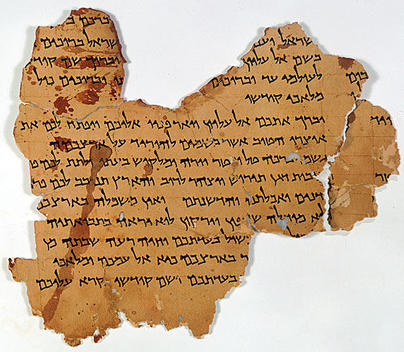
There is an interesting "prehistory" of sorts to the Prayer of Manasseh. Just as Psalm 151 is preserved in the Septuagint and was discovered in the last century in its Hebrew original among the Dead Sea Scrolls so there seems to be a similar phenomena with the Prayer. The Greek version of Psalm 151 and the Hebrew are different and yet the same psalm. In Cave Four of Qumran a damaged scroll was found that contained various prayers used apparently for worship. Among those prayers was 4Q381 which reads

The prayer of Manasseh, king of Judah, when the king of Assyria imprisoned him
.... my God .... is near,
My deliverance is before your eyes ....
For the deliverance your presence brings I wait, and I shrink before you
Because of [my sins,] for You have been very [merciful]
while I have increased my guilt, and so .... from enduring joy,
but my spirit will not experience goodness for ....
You lift me up, high over the Gentile ....
though I did not remember You ....
.... I am in awe of You, and I have been cleansed of the abominations I destroyed.
I made my soul to submit to You ... they increased its sin,
and plot against me to lock me up; but I have trusted in You ....
do not give me over to be tried, with You, O my God ....
they are conspiring against me, they tell lies .... to me deeds of
....[3]

The text preserved by the church has clear connections with this tradition of Manasseh's prayer.

The Prayer of Manasseh

The Prayer as it has come down to us is a mere fifteen verses long. Read against the backdrop of the darkness of incarnate evil the Prayer is nothing short of breathtaking. This is the the New Revised Standard Version's translation

1 O Lord Almighty,
God of our ancestors,
of Abraham and Isaac and Jacob
and of their righteous offspring;


2 you who made heaven and earth
with all their order;


3 who shackled the sea by your word of command,
who confined the deep
and sealed it with your terrible and glorious name;


4 at whom all things shudder,
and tremble before your power,


5 for your glorious splendor cannot be borne,
and the wrath of your threat to sinners is unendurable;


6 yet immeasurable and unsearchable
is your promised mercy,


7 for you are the Lord Most High,
of great compassion, long-suffering, and very merciful,
and you relent at human suffering.
O Lord, according to your great goodness
you have promised repentance and forgiveness
to those who have sinned against you,
and in the multitude of your mercies
you have appointed repentance for sinners,
so that they may be saved.


8 Therefore you, O Lord, God of the righteous,
have not appointed repentance for the righteous,
for Abraham and Isaac and Jacob, who did not sin against you,
but you have appointed repentance for me, who am a sinner.


9 For the sins I have committed are more in number
than the sand of the sea;
my transgressions are multiplied, O Lord, they are multiplied!
I am not worthy to look up and see the height of heaven
because of the multitude of my iniquities.


10 I am weighted down with many an iron fetter,
so that I am rejected because of my sins,
and I have no relief;
for I have provoked your wrath
and have done what is evil in your sight,
setting up abominations and multiplying offenses.


11 And now I bend the knee of my heart,
imploring you for your kindness.


12 I have sinned, O Lord, I have sinned,
and I acknowledge my transgressions.


13 I earnestly implore you,
forgive me, O Lord, forgive me!
Do not destroy me with my transgressions!
Do not be angry with me forever or store up evil for me;
do not condemn me to the depths of the earth.
For you, O Lord, are the God of those who repent,


14 and in me you will manifest your goodness;
for, unworthy as I am, you will save me according to your great mercy,


15 and I will praise you continually all the days of my life.
For all the host of heaven sings your praise,
and yours is the glory forever. Amen.


Listening to the Heartbeat of Second Temple Jewish Spirituality

Ben Sira surely is not far from the mark when he exhorts sinners to "Return unto the Lord, and forsake sins: Make thy prayer before his face, and lessen the offense. Turn again to the Most High, and turn away from iniquity; And greatly hate the abominable thing" (Sirach 17.25-26, Revised Version). Clearly in the Prayer the king has turned to God and despises "the abominable thing" (I love that turn of phrase in the Revised Version).

Verses 1-4 extol the power and majesty of God in creation (God's hesed is frequently seen in and through creation in the biblical psalms cf. Ps 104, Ps 136). The majesty of God is unendurable for sinners (v.5) Though God's holiness is potentially dangerous Manasseh swiftly moves to a meditation on the "heartbeat of the Hebrew Bible" ... Exodus 34.6-7 (the text thunders through the Story of Israel, See Num 14.17-18; Neh 9.16-17; Ps 86.15; Ps 148.8; Jonah 4.2; Joel 2.13; etc). In that Mt. Everest of biblical texts Yahweh reveals his true nature, his true glory in the face of Israel's "abominable" betrayal of the Covenant of Love by declaring a Golden Calf to be their God (this is adultery on the honeymoon!). Manasseh, like Israel of old, deserves certain death but discovers (like Job who had "heard" but now "sees") the true nature of his God. Here is the core of what follows in the prayer:

"immeasurable and unsearchable is your promised mercy,
for you are the Lord Most High,
of great compassion, long suffering, and very merciful,
and you relent at human suffering
."

As David poured out his heart to the Lord "I know my transgressions, and my sin is ever before me. Against you, you alone have I sinned ..." (Ps 51.3-4a) so Manasseh, incarnate evil, cries "for the sins I have committed are more in number than the sand of the sea my transgressions are multiplied, O Lord, they are multiplied!" Like the poor tax collector (who more than slightly "echoes" the language of Manasseh!) that would not even "look up to heaven" but implored "God, be merciful to me, a sinner!" (Luke 18.13), Manasseh confesses he is unfit to even "look up and see" the height of heaven.

Here is, again in my opinion, one of the most beautiful and memorable phrases in all spiritual literature. The need for divine forgiveness and acceptance is expressed in unforgettable poetry. The Prayer says

"And now I bend the knee of my heart imploring you for your kindness.
I have sinned, O Lord, I have sinned,
and I acknowledge my transgressions
."

The penitent prayer warrior places emphasis (in the preserved Greek text anyway) upon his unworthiness. Yet the petition is simultaneously bold for the verb aniemi (aorist imperative) rendered "forgive" in v.13 means to "let go unpunished."[4] Evil Incarnate dares to pray to go unpunished! He has no doubt of his unworthiness but he dares ... dares ... to pray to go unpunished! What a radical, shocking unveiling in this Jewish prayer ...

Verse 14 is perhaps the climax of the prayer. It is here that the sinner, that is as dark as the blackest night, exudes a confidence in his God that is truly astonishing. So astounding those clouded by their anti-semitic glasses could not imagine a Jew praying with such confidence in God. But here it is ...

"for unworthy as I am, you WILL save me
according to your great mercy
."

The TEV captures something of the "mood" here: "Show me all your mercy and kindness and save me, EVEN THOUGH I DO NOT DESERVE IT."

This confident assurance though is in complete harmony with the Story told, sang and prayed throughout the "Old Testament." In fact this confident assurance in the character of God is rooted in the confession, the Creed of Israel, in vv. 6-7 (Ex 34.6-7). God's mercy, by his own testimony, is infinite. The Prayer of Manasseh is a light of grace bursting upon the darkness. The confidence, the assurance, of the believer in the God who forgives (lets go unpunished) is the result of the light of grace.

The only response Manasseh can have to such unbelievable grace and mercy is to worship the King of Grace. "I will praise you continually all the days of my life." So should we.

Concluding Reflections

The great Jewish scholar, Samuel Sandmel, is quoted in the Forward of David deSilva's Introducing the Apocrypha as saying the Prayer of Manasseh "should have been 'canonized' within the liturgy of the Day of Atonement" (p.9). Charlesworth in fact speculates that the Prayer was indeed used in the Temple prior to its destruction in AD 70. We cannot, with the extant materials, prove Charlesworth's speculation but we do know that the message of Prayer was treasured by ancient Christians and used during worship. The Prayer was part of congregational worship by Christians early on. It survives Syriac, Coptic, Greek, Latin and was frequently gathered with other "prayer texts" for congregational use.

The Prayer has been included in the long line of English Bibles. The Geneva Bible of 1560 separates the Prayer from the rest of the Apocrypha (which is placed between the Testaments) and includes it as either an appendix or last chapter to 2 Chronicles. There is a marginal note that reads simply "This prayer is not in the Ebrewe, but is translated out of the Greeke." The King James Version removed the Prayer from the end of Chronicles and placed it with the rest of the Apocrypha between the Testaments.

The Prayer of Manasseh is indeed the heartbeat of Second Temple Jewish spirituality. If this prayer reveals the author's "doctrine of God" then that doctrine is wholesome. God is not merely a computer of justice. God is also the gracious Father. Anyone familiar with Greek gods in the myths appreciates the gulf between the two conceptions of deity. From Manasseh (and many other prayers of the time) a holy but gentle even intimate quality is revealed. One never wants to get to near the gods in Greek religion. This prayer proclaims that even the worst of sinners, incarnate evil, can find mercy, compassion and forgiveness from the God of Abraham, Isaac and Jacob. No wonder the church got on her knees with Manasseh and prayed ... and was ushered into the heart of God.

Notes:

The artwork, The Prayer of Manasseh, is by C. P. Marillier the 18th century French artist.

[1] See on a friendly and engaging level Bill T. Arnold and David B. Weisberg, "Babel und Bibel und Bias: How Anti-Semitism Distorted Friederich Delitsch's Scholarship," Bible Review 28 (February 2002): 32-40, 47.

[2] James H. Charlesworth, "Prayer of Manasseh" in Old Testament Pseudepigrapha, vol 2. pp. 625-633.

[3] Translation taken from The Dead Sea Scrolls: A New Translation, by Michael Wise, Martin Abegg Jr & Edward Cook. The translation of 4Q381 in Geza Vermes The Complete Dead Sea Scrolls reads slightly different. See also "An Qumran Fragment of the Ancient 'Prayer of Manasseh,' Zeitschrift für die alttestamentliche Wissenschaft 108 # 1 1996, p 105-107

[4] See the Greek text of Manasseh in John R. Kohlenberger III, ed. The Parallel Apocrypha: Greek, King James Version, Douay, Knox, Today's English Version, Revised Standard Version, New American Bible, New Jerusalem Bible (Oxford University Press, 1997), p. 1070.
Read More
Posted in Apocrypha, Bible, Church History, Grace, King James Version, Prayer, Spiritual Disciplines, Worship | No comments

Saturday, July 23, 2011

Baruch and the Letter of Jeremiah: Don't Fear, They are not Gods

Posted on 2:44 PM by Unknown

Baruch

Introduction

Baruch along with the Letter of Jeremiah are probably among the earliest (i.e. oldest) of the writings contained in the Old Testament Apocrypha. Because of the abundance of “Hebraisms” the original language of these works is believed to be Hebrew. The now lost Hebrew originals were written sometime between 300 and 160 B.C. for Baruch and 317 and 306 B.C. for the Letter of Jeremiah (the issues are complicated but for the curious see, David deSilva, Introducing the Apocrypha, pp. 204-205 and 216-217). The Letter of Jeremiah has been found among the Dead Sea Scrolls. Baruch has not been identified among the DSS, however, since the Letter was often chapter 6 of Baruch we cannot be certain that Baruch was not among the Scrolls. Baruch has a composite nature so parts of the book are older than others.

Interestingly enough there is a historical “blunder” in Baruch. Baruch 1.11 for example says that Belshazzar was Nebuchadnezzar’s son as does Daniel 5.2, etc. There is an historical problem here (Belshazzar was not N’s son but Nabonidus) and the relation between Daniel and Baruch is disputed at this point.

Baruch: The Confessional Prayer

Baruch is made of five chapters containing a variety literary forms. The book opens with a narrative similar to Nehemiah 8-9 and 2 Kings 22.8-13. The narrative creates a setting in which Baruch “reads” to the exiles in Babylon after the destruction of the Temple in 586 B.C. (the date “in the story” would be around 582). Interestingly enough Baruch contains the command to read the book in the “house of the Lord”:

“And you shall read aloud this scroll that we are sending you, to make your confession in the house of the Lord on the days of the festivals and at appointed seasons” (Baruch 1.14).

This is interesting because Protestant apologists have frequently said that no apocryphal book claims to be authoritative ... one wonders what this text is claiming?

The first major section of the book (1.15-3.8) contains a prayer of confession. In this the Jews take full blame for the disaster that has befallen them. It is because of their faithlessness to the covenant that Yahweh has disciplined them,

“we have sinned before the Lord. We have disobeyed him, and have not heeded the voice of the Lord our God, . . . From the time when the Lord brought our ancestors out of the land of Egypt until today, we have been disobedient to the Lord our God . . .” (Baruch 1.17-19)

“We have sinned, we have been ungodly, we have done wrong . . .” (2.12)

The prayer reveals a repentant heart on Baruch’s, and the Exiles, part. The prayer also has a firm belief that God is a merciful God. So not only do we see confession of sins and remorse but we see pleas based upon the grace of the Lord. Notice that the writer does not believe that Israel merited any blessing from the Lord,

“Hear, O Lord, our prayer . . . and for the sake of your own sake deliver us, and grant us favor . . .” (Baruch 2.14)

“For it is not because of any righteous deeds of our ancestors or our kings that we bring before you our prayer for mercy, O Lord our God.” (Baruch 2.19)

In spite of the exile, Baruch, confesses that God has been good and dealt with Israel in “kindness.” The book appeals directly to the promise of God in Deuteronomy 4.25-31, that should exile come because of sin, God will heal and restore Israel if they call on him.

That is why Baruch prays,

“you have dealt with us, O Lord our God, in all your kindness and in all your great compassion, as you spoke by your servant Moses . . . For I know that they will not obey me, for they are a stiff-necked people. But in the land of their exile they will come to themselves and know that I am the Lord their God. I will give them a heart that obeys and ears that hear . . . I will bring them back again into the land” (Baruch 2. 27, 30-31, 34).

Baruch: The Psalm of Praise

The second major section of Baruch is a hymn of praise to wisdom – the wisdom of serving God alone. Wisdom is of incredible value and it is because Israel did not value wisdom that she is now in a “foreign country” (Baruch 3.10). In its context, the hymn helps Israel to do what they prayed – turn their hearts back to God. But it is only by being devoted to the “book of the commandments of God” (Baruch 4.1) that she can ever hope to live. Note that wisdom according to Baruch is not simply philosophy but it is in fact the words of God that embody wisdom. These words bring life (cf. John 5.39; 6.63, 68) if they are clung too.

Though there is much that is worthy of attention in this section we can only examine Baruch 3.35-37. This particular passage played an important role in the early church. The “Church Fathers” repeatedly appealed to this text as referring to Jesus Christ. The text reads,

This is our God; no one can compare to him.
He found the whole way to knowledge,
and gave her to his servant Jacob and to
Israel, whom he loved.
Afterward she appeared on earth and lived with humankind
.
(Baruch 3.35-37).

Early Christians like Origen, Cyprian, Tertullian and Lactantius along with a host of others thought this was prophecy of the Incarnation and the growth of Christianity among the Gentiles.

Baruch: Zion is Encouraged

The last section of Baruch (4.5-5.9) is a personification of Zion (Jerusalem) as she provides hope for the future to a disgraced and exiled people. Zion expresses her grief at seeing her “children” taken off into captivity. She has “faith” however that God will deliver them if they turn to God (4.5-29). Repeatedly the exiles are exhorted to “take courage” (4.5, 21, 27, 30) because God has not cast off his people forever. Here are a few choice texts,

“For he who brought these calamities upon you
will deliver you from the hand of your enemies
”
(Baruch 4.18).

“I sent you out with sorrow and weeping,
but God will give you back to me with
joy and gladness forever
.” (Baruch 4.23)

“Look, your children are coming, whom
you sent away; they are coming, gathered
from east and west, at the word of the Holy
One, rejoicing in the glory of God
.”
(Baruch 4. 37).

“For God will lead Israel with joy,
in the light of his glory, with the mercy
and righteousness that come from him
.”
(Baruch 5.9).

Baruch moves from confession of sin and acknowledgement of the righteous judgment of
God. Then the book exhorts us to find true life and wisdom through the word of God. And finally the book closes with the promise of God grace and mercy in the return of the exiles. The final verse, quoted above, is a beautiful image to behold. God is leading his children with joy and mercy down the highway to a beautified Jerusalem.


The Letter of Jeremiah

The Letter of Jeremiah is not really a “letter” but a polemic against Babylonian (and pagan) religion. “Jeremiah” writes instructing the first exiles to keep their faith in Yahweh in a world that is surrounded by beautiful and awe inspiring idols. “Jeremiah” seeks to inoculate these deportees by showing the ridiculous nature and status of an image. This was indeed a relevant message to Jews any time during their history and is just as relevant to Christians: idolatry is false and we need not fear those things in our lives that would claim to be deity that have no claim.

Basic Facts about the Letter

The Letter of Jeremiah is most likely the oldest of the Apocrypha. Based upon 6.3 “up to seven generations” which describes the length of the Exile will be, scholars deduce the book was written in the late fourth century around, 317 to 306 B.C. (see deSilva, Introduction to the Apocrypha, pp. 216-217 and Carey A. Moore, The Anchor Bible: Daniel, Esther, and Jeremiah: The Additions, pp. 327-328, 335). Other factors go into the date of the book as well: 1) enough time has to be allowed for it to be translated into Greek prior to inclusion in the Septuagint; 2) the fact that it is referred to in 2 Maccabees 2.1-2, 4 as being written by Jeremiah (2 Macc itself dates approximately around 100 B.C.); 3) it being found among the Dead Sea Scrolls.

The order of the Jeremiah “corpus” of material in the Greek tradition is different than in the Latin tradition. In the great codices Vaticanus and Alexandrinus the order is Jeremiah, Baruch, Lamentations, Letter of Jeremiah. In the Syriac and the Latin the Letter of Jeremiah is added to Baruch becoming chapter 6 (Jerome is responsible for this). Most modern versions for some reason still number the Letter as chapter six even though it is set by itself as it should be.

The content of the Letter of Jeremiah parallels numerous biblical passages on idolatry. As to be expected there are echoes of Jeremiah in the Letter. For example Jeremiah 10. 1-15 contains a parody on idols as well and surely provides grist for the author of the Letter. Other passages where humor is extended at the expense of idols can be found in Isaiah 44.9-20 and Psalm 115.3-8.

Literary Outline

The Letter of Jeremiah is divided up into ten sections each being marked with a negation of the reality of pagan gods. This negation serves as a refrain through the Letter as an organizing principle, “From this it is evident they are not gods; so do not fear them” (vv. 16; 23; 29; 65; and 69) or “Why then must anyone think that they are gods, or call them gods?” (vv. 40; 44; 52; 56; and 64). The Letter closes with an affirmation of the honor of the person who does not degrade himself into worshipping idols (v.73). The thundering refrain in the Letter is similar (in purpose) to the refrains in such biblical passages as Psalm 42 and 43 (one psalm) and Psalm 107.


Choice Texts

“When you see the multitude before and behind them [idols] worshipping them Say in your heart, ‘It is you, O Lord, whom we must worship.” For my [God’s] angel is with you, and he is watching over your lives.” (vv. 6-7)

“They [idols] are just like a beam of the temple, but their hearts, it is said, are eaten away when crawling creatures from the earth devour them and their robes. They do not notice . . .” (v. 20).

“How can one fail to see that these are not gods, for they cannot save themselves from war or calamity?” (v. 49).

“So it is better to be a king who shows his courage, or a household utensil that serves its owner’s need, than to be these false gods; better even the door of a house that protects its contents, than these false gods; better a wooden pillar in a palace, than these false gods.” (v. 59).

“Like a scarecrow in a cucumber bed, which guards nothing, so are their gods of wood . . .” (v. 70).

Because all of this is so, then . . .

“Better, therefore, is someone upright who has no idols; such a person will be far above reproach.” (v. 73).

Baruch and the Letter of Jeremiah are among the lesser important Apocrypha. However they were both frequently simply "went along" with Jeremiah like Lamentations did in the ancient church. They have a place in the history of the Bible and were part of the English Bible tradition for hundreds of years. Both were included in the King James Version.
Read More
Posted in Apocrypha, Bible, Jeremiah, Jewish Backgrounds, King James Version | No comments
Older Posts Home
Subscribe to: Posts (Atom)

Popular Posts

  • Alexander Campbell, Rebaptism & Sectarianism
    The immersion of Alexander Campbell in 1812 by Baptist preacher Mathias Luce has been long been a troublesome issue for some heirs of the St...
  • Prayer in the Apocrypha 3: Judith's Psalm of Praise
    " Therefore this is a fine, good, holy, useful book, well worth reading by us Christians. For the words spoken by the persons in it s...
  • What the "Assembly" is "About in the Psalms: Special Attention to Ps 95
    In Scripture a Spiritually minded worshiper comes to the assembly (i.e. gathering) of the People of God desiring five things: 1) The worshi...
  • (no title)
    Snow in the Desert ... at least on the Mountains While the rest of the country has been getting pummeled with ice and snow ... old man winte...
  • Tulsa Workshop Anyone...
    I was at the Tulsa Workshop a couple years ago when John Mark Hicks and I spoke together. I didn't make it last year due to other commi...
  • Jonah #7: God's Heart & His Struggle with Israel (Symmetry & Irony )
    " Salvation comes from and belongs to the LORD " (Jonah 2.9, BV) Frequently in this series of essays on Jonah, I have stressed tha...
  • Uncle Tom's Cabin, The Bible & America, #2
    " Reading the Bible with the eyes of the poor is a different thing than reading the it with a full belly. If it is read in the light of...
  • Paul and the Unquestioned Authority of the "Old Testament"
    This is a revised and slightly expanded version of a "note" I had placed on my Facebook. May it bless you as we wrestle together w...
  • Things I Do NOT Believe
    Some times people will attempt to write a short summary of what they believe and hold dear. This summary is often called a creed. Because I ...
  • Reframing the Question: Exercise in Hermeneutics and Grace
    I am taking a brief diversion from our mediations on Jesus &  Sabbath to reflect on a question that was put to me the other day. It is ...

Categories

  • 1 Corinthians (3)
  • 1 Thessalonians (1)
  • 1 Timothy (1)
  • A Gathered People (3)
  • Abraham (1)
  • Acts (2)
  • Africa (1)
  • Alexander Campbell (23)
  • American Empire (1)
  • Amos (5)
  • Apocrypha (24)
  • Apologetics (1)
  • Baptism (10)
  • Barack Obama (1)
  • Barton W. Stone (3)
  • Benjamin Banneker (1)
  • Bible (107)
  • Black History (17)
  • Bobby's World (187)
  • Books (66)
  • C. S. Lewis (1)
  • Carl Ketherside (1)
  • Christian hope (57)
  • Christmas (14)
  • Christology (1)
  • Church (53)
  • Church History (84)
  • Clay Parkinson (1)
  • Colossians (7)
  • Contemporary Ethics (56)
  • Cool Stuff (2)
  • Culture (3)
  • Daniel (2)
  • David Lipscomb (6)
  • Deuteronomy (6)
  • Didache (1)
  • Discipleship (29)
  • Doug Doser (1)
  • Easter (3)
  • Ecclesiastes (3)
  • Environment (1)
  • Ephesians (4)
  • eschatology (25)
  • Esther (1)
  • Exegesis (149)
  • Exodus (2)
  • Faith (11)
  • Family (24)
  • Famiy (1)
  • Football (1)
  • Forgiveness (1)
  • Frederick Douglass (1)
  • Galileo (1)
  • Genesis (1)
  • Gnosticism (1)
  • Gordon Fee (1)
  • Gospel of John (1)
  • Gospel of Judas (1)
  • Grace (46)
  • Habakkuk (2)
  • Hanukkah (1)
  • Harriet Beecher Stowe (1)
  • Heaven (6)
  • Hebrew Bible (97)
  • Hebrews (2)
  • Hermeneutics (113)
  • Holding On (2)
  • Holy Kiss (1)
  • Holy Spirit (12)
  • Humor (7)
  • J. W. McGarvey (3)
  • J.N. Armstrong (1)
  • James (2)
  • James A. Harding (5)
  • James Challen (1)
  • Jeremiah (3)
  • Jerry Rushford (1)
  • Jesus (79)
  • Jewish Backgrounds (19)
  • John Lennon (1)
  • John Newton (1)
  • John Waddey (1)
  • John Wyclif (1)
  • Jonah (10)
  • Jonathan Edwards (2)
  • Journey (8)
  • Jude (1)
  • Judith (2)
  • K. C. Moser (6)
  • King David (1)
  • King James Version (23)
  • Kingdom (118)
  • Kingdom Come (4)
  • Lectures (10)
  • Lord's Supper (4)
  • Love (4)
  • Luke (2)
  • Mark (1)
  • Marriage (2)
  • Martin Luther (1)
  • Martin Luther King (3)
  • Matthew (1)
  • Milwaukee (6)
  • Ministry (175)
  • Mission (43)
  • Monroe Hawley (1)
  • Moses Lard (1)
  • Movies (1)
  • Music (62)
  • N.T. Wright (5)
  • Nahum (2)
  • New Mexico (1)
  • Numbers (1)
  • Pardee Butler (1)
  • Patternism (4)
  • Paul (2)
  • Personal (11)
  • Philippians (1)
  • Politics (4)
  • Prayer (46)
  • Preaching (152)
  • Psalms (15)
  • R. C. Bell (1)
  • R. H. Boll (1)
  • Race Relations (21)
  • Reading (2)
  • Restoration History (77)
  • resurrection (2)
  • Revelation (1)
  • Richard Oster (1)
  • Romans (3)
  • S. R. Cassius (1)
  • Sabbath (2)
  • Salvation (2)
  • Sectarianism (8)
  • Septuagint (1)
  • Sexuality (2)
  • Sirach (1)
  • Slavery (2)
  • Song of Songs (4)
  • Spiritual Disciplines (50)
  • Suffering (11)
  • Tags (7)
  • Theodicy (2)
  • Tobit (3)
  • Tucson (22)
  • Uncle Tom's Cabin (2)
  • Unity (35)
  • Veggie Tales (1)
  • Walter Scott (1)
  • War -Peace (8)
  • Wisdom of Solomon (2)
  • Women (7)
  • Worship (43)

Blog Archive

  • ▼  2013 (23)
    • ▼  August (8)
      • What the "Assembly" is "About in the Psalms: Speci...
      • Prayer in the Apocrypha 3: Judith's Psalm of Praise
      • Paul and the Unquestioned Authority of the "Old Te...
      • Rocks, Martin & Psalm 62
      • Barton W. Stone & the Debate Culture
      • C. S. Lewis: Love is an Undying Fire
      • Can the King be Trusted? The Vision of Psalm 73
      • Prayer in the Apocrypha 2: Tobias & Sarah's Weddin...
    • ►  July (2)
    • ►  June (5)
    • ►  May (2)
    • ►  March (1)
    • ►  February (3)
    • ►  January (2)
  • ►  2012 (33)
    • ►  December (4)
    • ►  November (4)
    • ►  October (1)
    • ►  August (2)
    • ►  July (1)
    • ►  June (4)
    • ►  May (3)
    • ►  April (1)
    • ►  March (4)
    • ►  February (4)
    • ►  January (5)
  • ►  2011 (58)
    • ►  December (7)
    • ►  November (1)
    • ►  October (3)
    • ►  September (4)
    • ►  August (9)
    • ►  July (6)
    • ►  June (7)
    • ►  May (6)
    • ►  April (5)
    • ►  March (4)
    • ►  January (6)
  • ►  2010 (49)
    • ►  December (4)
    • ►  November (2)
    • ►  October (6)
    • ►  September (1)
    • ►  August (8)
    • ►  July (7)
    • ►  June (1)
    • ►  May (7)
    • ►  April (2)
    • ►  March (5)
    • ►  February (4)
    • ►  January (2)
  • ►  2009 (61)
    • ►  December (9)
    • ►  October (4)
    • ►  September (4)
    • ►  July (1)
    • ►  May (10)
    • ►  April (3)
    • ►  March (5)
    • ►  February (17)
    • ►  January (8)
  • ►  2008 (131)
    • ►  December (12)
    • ►  November (10)
    • ►  October (13)
    • ►  September (19)
    • ►  August (13)
    • ►  July (13)
    • ►  May (15)
    • ►  April (13)
    • ►  March (11)
    • ►  February (7)
    • ►  January (5)
  • ►  2007 (115)
    • ►  December (5)
    • ►  November (2)
    • ►  October (7)
    • ►  September (9)
    • ►  August (9)
    • ►  July (11)
    • ►  June (7)
    • ►  May (17)
    • ►  April (15)
    • ►  March (12)
    • ►  February (11)
    • ►  January (10)
  • ►  2006 (30)
    • ►  December (11)
    • ►  November (6)
    • ►  October (10)
    • ►  September (3)
Powered by Blogger.

About Me

Unknown
View my complete profile